To enter the world of Michelangelo Antonioni’s Red Desert (Il deserto rosso, 1964) is to witness the birth of a new cinematic language. It is a film that does not simply use colour, but weaponizes it, transforming the physical world into a direct, unmediated expression of a character’s psyche. Set against the backdrop of the industrial wasteland of Ravenna, the film follows Giuliana (a transcendent Monica Vitti), a woman grappling with a profound sense of dislocation following a car accident. But Antonioni makes it clear that her neurosis is not merely a personal malady; it is a symptom of a much larger, modern sickness. The film is a devastating diagnosis of an age where humanity has built a world of terrifying scale and chemical beauty, a world to which the human soul is no longer properly adapted.
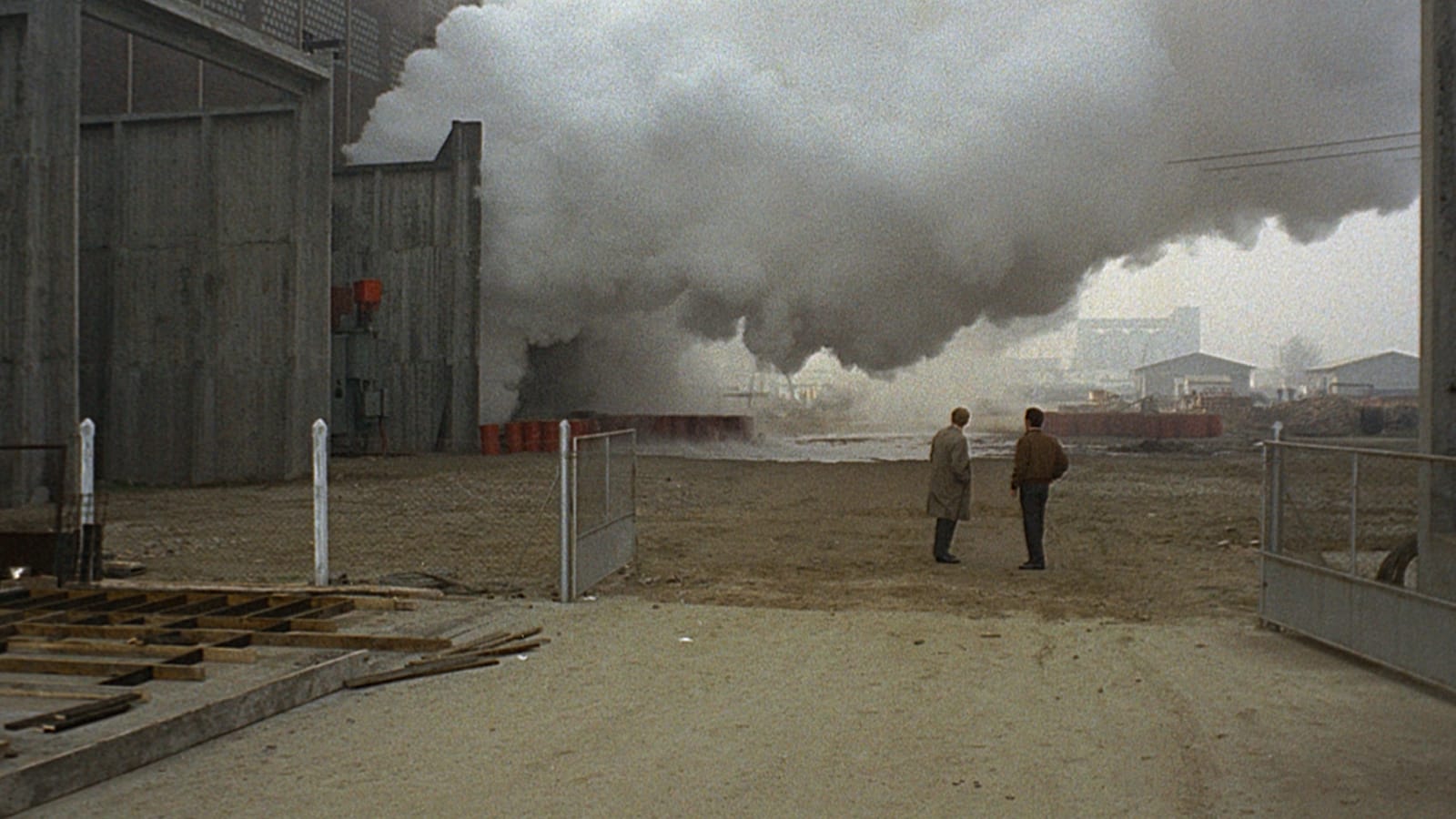
Antonioni famously stated, "I want to paint the film as one paints a canvas." This principle is the key to unlocking Red Desert. The film’s colour palette is deliberately and radically subjective. It is a world seen entirely through Giuliana’s fractured consciousness. Antonioni and cinematographer Carlo Di Palma achieve this not just through filters, but by literally painting the landscape—trees are coated in mournful grey, a fruit vendor’s cart is rendered in muted, unappetizing tones to drain it of life. The environment is not a passive backdrop; it is an active participant in her alienation. Towering factory structures, belching pipes, and ships that appear like metallic monsters out of the ever-present fog are framed with a telephoto lens that flattens perspective, trapping Giuliana within a hostile, geometric prison. The out-of-focus backgrounds, the soft blurs of colour and shape, are not technical errors but a precise visual representation of her inability to connect with and comprehend her surroundings.
The industrial landscape of Ravenna is the film’s central character. It is a world of inhuman beauty and palpable toxicity. The plumes of yellow smoke, the iridescent slicks on polluted water, the fiery bursts from factory smokestacks—Antonioni presents these not with condemnation, but with a kind of awestruck horror. This is the new nature, a sublime of steel and chemical waste. The sounds of this world are just as crucial as its sights. The score is a disquieting electronic hum, punctuated by the shrieks, clangs, and drones of machinery. This industrial soundscape is relentless, bleeding into every scene and refusing to allow for a moment of quiet contemplation. It is the constant, nerve-shredding soundtrack of modernity, a world where silence and serenity have been rendered obsolete.
Giuliana’s journey is one of failed connections. Her husband, Ugo (Carlo Chionetti), is an engineer, a man perfectly integrated into this new world. He is kind but unseeing, unable to comprehend the source of her existential dread. Corrado (Richard Harris), a visiting businessman, seems to offer a potential for escape and understanding. He too is a transient, adrift in this world, yet his alienation is one of boredom, not terror. Their brief, fumbling affair is not an act of passion but of shared desperation, a clumsy attempt to feel something, anything, in a world that deadens sensation. The film’s most famous sequence, the party in the riverside shack, is a masterclass in depicting this communal breakdown. The characters engage in aimless, sexually charged chatter, their attempts at intimacy feeling hollow and performative, all while the massive form of a ship silently glides past their window, a reminder of the indifferent industrial world that dwarfs their petty anxieties.
The only true escape is into fantasy. In a brief, heartbreaking interlude, Giuliana tells her son a story about a young girl on a pristine pink beach, where the rocks mysteriously "sing." The sequence is shot with a vibrant, naturalistic palette that stands in stark contrast to the rest of the film. It is a vision of a pure, magical, pre-industrial world—a world of connection between humanity and nature. But it is only a fable, an imagined paradise that makes the return to the grey reality of Ravenna all the more crushing. The singing rocks are an impossible dream in a world deafened by the roar of machines.
Red Desert concludes not with a resolution, but with a moment of bleak, ambiguous adaptation. Giuliana stands with her son, watching a factory chimney emit a plume of yellow smoke. The boy asks if the smoke is poisonous. "Yes, it is," she replies, before adding that the birds have learned not to fly through it anymore. This is the film’s devastating thesis. There is no escape from this toxic modernity. One cannot overcome it or return to a lost Eden. The best one can hope for is to learn how to navigate the poison, to adapt one's flight path to survive. The film is a profound and prophetic vision of ecological anxiety and spiritual exhaustion, a painterly masterpiece that argues that the most terrifying landscapes are not on a distant planet, but the ones we have built around ourselves, and the desolate internal worlds they create in turn.