There is a sensation familiar to many, yet seldom voiced: reality has crossed a threshold where conventional explanations no longer suffice. Institutions designed to inspire trust instead provoke suspicion. Expert knowledge sounds too polished, increasingly resembling ideological packaging. The information flow does not clarify; it obfuscates. Post-pandemic anxiety hasn't vanished—it has dissolved into the fabric of the everyday, becoming a background noise we no longer notice. In this climate, Yorgos Lanthimos’s Bugonia asks: what happens when the desire to save the world renders a person subhuman? The film forces a confrontation between two moralities: the conspiracy theorist ready to torture for "the truth," and the corporate leader ready to write off an entire species to "save the planet." Both are convinced of their righteousness.
Four Days Until the Eclipse
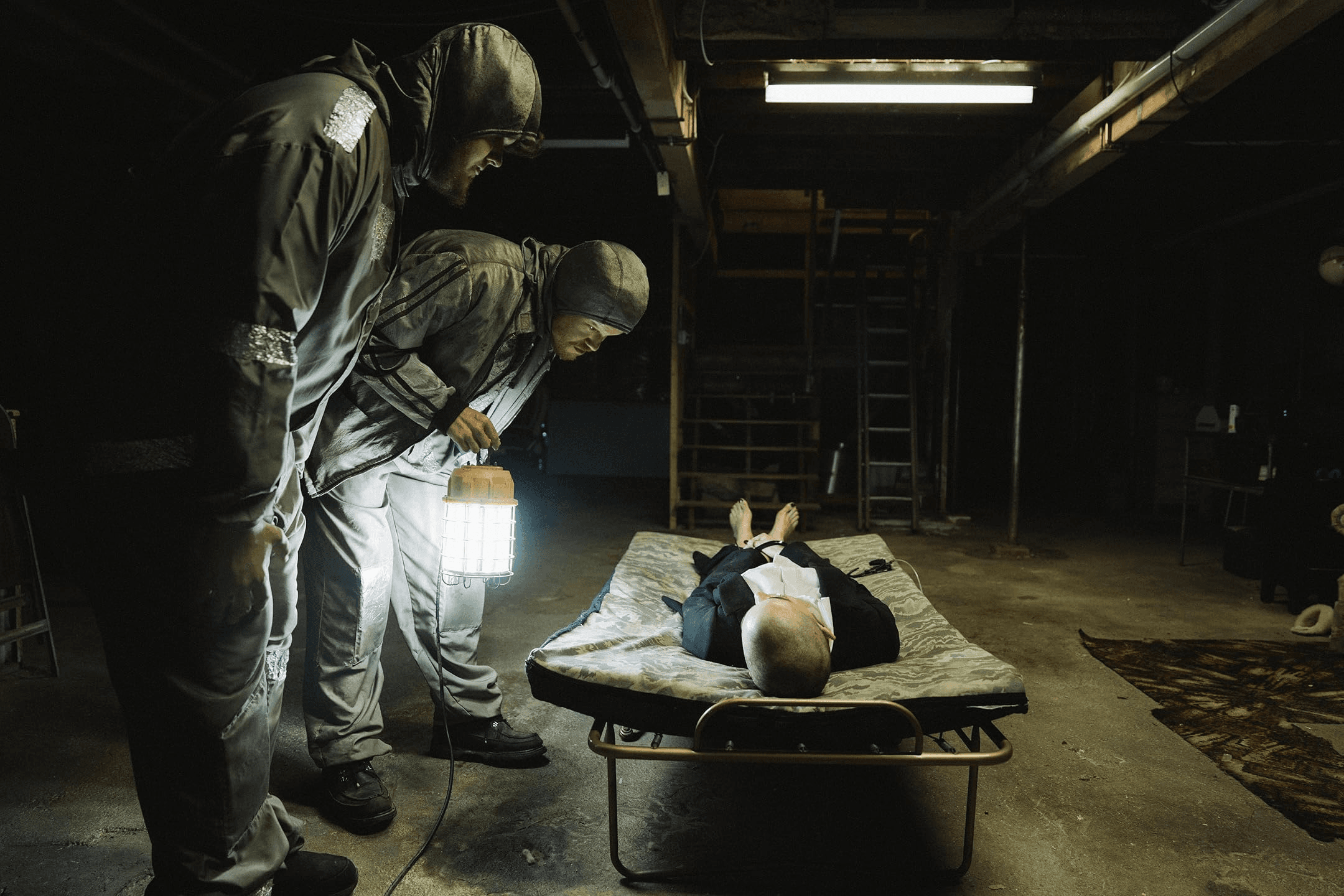
Bugonia is an English-language remake of Jang Joon-hwan’s South Korean cult classic Save the Green Planet! (2003). The plot is deceptively simple: Teddy (Jesse Plemons), a beekeeper, and his cousin Don (Aidan Dwalebs) kidnap Michelle Fuller (Emma Stone), the CEO of the pharmaceutical conglomerate Auxolith, and lock her in a basement. Teddy is certain: Michelle is an "Andromedan," a representative of an alien race that is destroying bee populations, dismantling human communities, and turning people into docile drones. She has four days until a lunar eclipse to arrange a meeting with the Andromedan Emperor; otherwise, their mothership will enter Earth’s atmosphere unopposed.
Teddy has a personal score to settle with Auxolith: his mother fell into a coma during a corporate clinical trial. This trauma appears to be the root of everything else—his distrust of power structures, the feeling that the promised "social elevator" was a scam, and the conviction that a ruthless machine grinds away behind the facade of normalcy. Teddy is a man the system chewed up and spat out: corporate indifference, police brutality, a broken family.
At the opposite pole is Michelle, the CEO. She delivers rehearsed speeches on workplace diversity, adheres to a strict "anti-aging diet," and sings along to Chappell Roan’s "Good Luck, Babe!"—a song about refusing to acknowledge the truth of one's feelings. Everything about her exudes the sterile composure of someone who remains insulated from consequences. Her humanism is a linguistic tool that sells medicine, environmental agendas, and the illusion of control with equal conviction.
Conspiracy as a Survival Strategy
One of the film's most unsettling threads is its portrayal of conspiratorial thinking—not as a caricature, but from within, with its own internal logic and pain.
When the official picture of the world fails to hold together, an acute need for alternative causality arises. A coherent system of explanations brings peace: finally, it is clear who is to blame, why this is happening, and what must be done. Teddy finds such a system in the Andromedans and the intergalactic conspiracy. Within this framework, cause and effect operate with total clarity.
The premise feels different today than it did in the early 2000s. Social media has transformed conspiracy theories from a marginal subculture into a mass phenomenon. Teddy is its quintessential product: an isolated paranoid whose politics defy classification. He dismisses information bubbles as "hegemonic nonsense" and unleashes a cascade of negations upon Michelle—"no rules," "no deals," "no market," "no Congress," "no America," "no global democratic order." It is a collapse of the very language she uses to hypnotize her interlocutors. Teddy calls these categories "false institutional shibboleths"—passwords of belonging that must be recited correctly just to be allowed into the conversation.
Yet, he rightly points to the erosion of meaning—a world where the link between politics and public interest feels severed. "Market," "Law," "Democracy"—these are no longer descriptions of reality, but ritual formulas used to maintain a hollow order. Teddy refuses to acknowledge the universality of institutions because, in his experience, the rules may exist on paper, but they no longer protect the weak or explain the world.
"False Humanity": Corporations, Police, and the Norm
The film refuses to let the viewer occupy the comfortable position of the "rational observer" who can easily separate madness from sanity. In the world of Bugonia, the "norm" is also a form of violence—merely structural and invisible.
Corporate evil is naturalized here: markets, competition, the strong devouring the weak. This is presented as the natural order of things requiring no justification. Mark Fisher described this state as "Capitalist Realism": a condition where it is easier to imagine the end of the world than an alternative to the current system. Auxolith maims people in clinical trials, but within corporate logic, this isn't a crime—it’s a statistic, a side effect of the mission. Michelle speaks the language of care—health, progress, the future of the planet—but this language operates entirely on the axes of efficiency and commerce.
In Bugonia, violence is saturated throughout the social structure: in the pharma lab, the police system, and an economy that indifferently pushes people overboard. Officer Casey, who comes looking for Michelle, is Teddy’s former babysitter; only a biographical accident separates the "protector of order" from the "violator." Corporate culture is, in this sense, more dangerous than overt violence: it privatizes the norm. It appropriates the concepts of truth and goodness, processes them into marketing speak, and sells them back to us. This is why Michelle’s speech is so terrifying; she translates violence into the language of utility and responsibility.
Two Moralities, One Mechanism
In a climactic shift, Michelle—bound, head shaved, exhausted by torture—reclaims control. She feeds Teddy an alternative version of his own conspiracy: the Andromedans, out of guilt for accidentally wiping out the dinosaurs, created humans in their own image. Atlantis was once peaceful, but early humans experimented with their genome, became aggressive, and started a nuclear war. Modern, more violent humanity is the descendant of the survivors. The Andromedans have spent millennia trying to guide us, and Auxolith’s experiments were part of that effort.
The scene is staged so the viewer loses their footing: who is manipulating whom? Michelle moves Teddy to tears; she masters his language better than he does. The core of the film is exposed. Teddy is "saving humanity," and this justifies electric shock, imprisonment, and murder. Michelle is "saving life and the planet," and this justifies the erasure of a species. Two moralities mirror each other: both operate through the category of salvation, both claim to know "how things should be," and both derive from that knowledge a right to kill. Lanthimos shows the mechanism by which conviction—any conviction, if strong enough—begets violence.
Any "world as a project"—whether corporate, conspiratorial, or ecological—implies the amputation of reality. To realize an ideal plan, everything that does not fit must be cut away. Every project of salvation destroys the world as it is, simply to make room for the world as it "ought to be."
Bees and Bugonia: Labor, Obedience, Sacrifice
The bees in the film function as an image on multiple levels. Teddy is a beekeeper, and the death of his hives symbolizes the death of the living world. This isn't mere fiction; commercial beekeepers in the US have reported unprecedented colony losses in recent years. Teddy diagnoses his hives with "Colony Collapse Disorder" and blames corporations polluting the atmosphere under alien direction. "Even if it were human," he says of the CEO, "its corporate cruelty killed the bees."
But bees are also an image of blind labor, obedience, and inertia. During a key dinner scene, Michelle remarks that she admires bees for their "work ethic," adding that this very industriousness makes them easy to exploit. The line cuts both ways. The working class, like bees, continues to labor under any threat—not out of loyalty, but because it knows no other way to exist. Corporations and their leaders also continue what they do—not out of conscious villainy, but out of the inertia of their roles.
The film’s title refers to an ancient myth. Bugonia (from the Greek bous—ox, and gone—progeny) was the belief that bees were spontaneously generated from the carcasses of dead oxen. In his Georgics, Virgil described how the beekeeper Aristaeus sacrificed cattle to birth a new swarm. Death as a condition for birth; renewal through sacrifice.
In the finale, Michelle annihilates humanity—and the bees slowly return to Teddy’s apiary. Bugonia is fulfilled: new life is born from sacrifice, but the sacrifice is the entire human race.
Don: Between Two Abysses
Between the poles of Teddy and Michelle sits Don. A quiet young man, Teddy’s cousin and assistant, he is the only character whose presence consists entirely of reacting to others. He absorbs everything they say, even when they contradict each other. Lanthimos emphasizes this through framing: Teddy and Michelle are often shown in alternating close-ups, delivering monologues, but the camera rarely shows the listener's reaction. They speak at each other. Don is the only one who lets the words in.
In the dinner scene, Teddy and Michelle engage in an intellectual duel, while Don sits between them like a child caught in a parental argument. Both sides manipulate him. When Michelle, attempting to escape, swears she will take Don to the Andromedan mothership, he believes her. And then he shoots himself.
Don’s suicide represents the point where the "game of ideas" becomes unbearable—a refusal to choose between two kinds of evil. The simple need for love and belonging that Don embodies has no place in any ideology. His death is the price paid by a world divided between fanatics.
Is There Salvation Without a Savior?
The finale of Bugonia resolves the central mystery: Michelle is an Andromedan. Teddy dies in an accidental explosion of a homemade suicide belt. Michelle returns to her office, enters a closet that doubles as a teleporter, and ascends to the mothership. She concludes that the human experiment has failed. With one gesture, the human race is extinguished. Animals, plants, and birds remain. The planet is saved.
The ultimate dilemma is this: if there is no one to trust, what can we lean on so that "care for the world" does not transform into violence? Eco-anxiety easily slides into extremism once one believes "saving the planet" is more important than preserving the species. Michelle, in her version of events, tried to help for millennia before deciding the only way out was to hit delete. Teddy sought to expose evil and became its instrument.
In this film, salvation is always the victory of one perspective over all others. Every idea, when pushed to its limit, demands a sacrifice—and that sacrifice is reality itself. Perhaps the answer—if one exists—lies in the ability not to tether oneself to a single idea, but to drift between them, holding onto uncertainty and refusing the monopoly on truth.