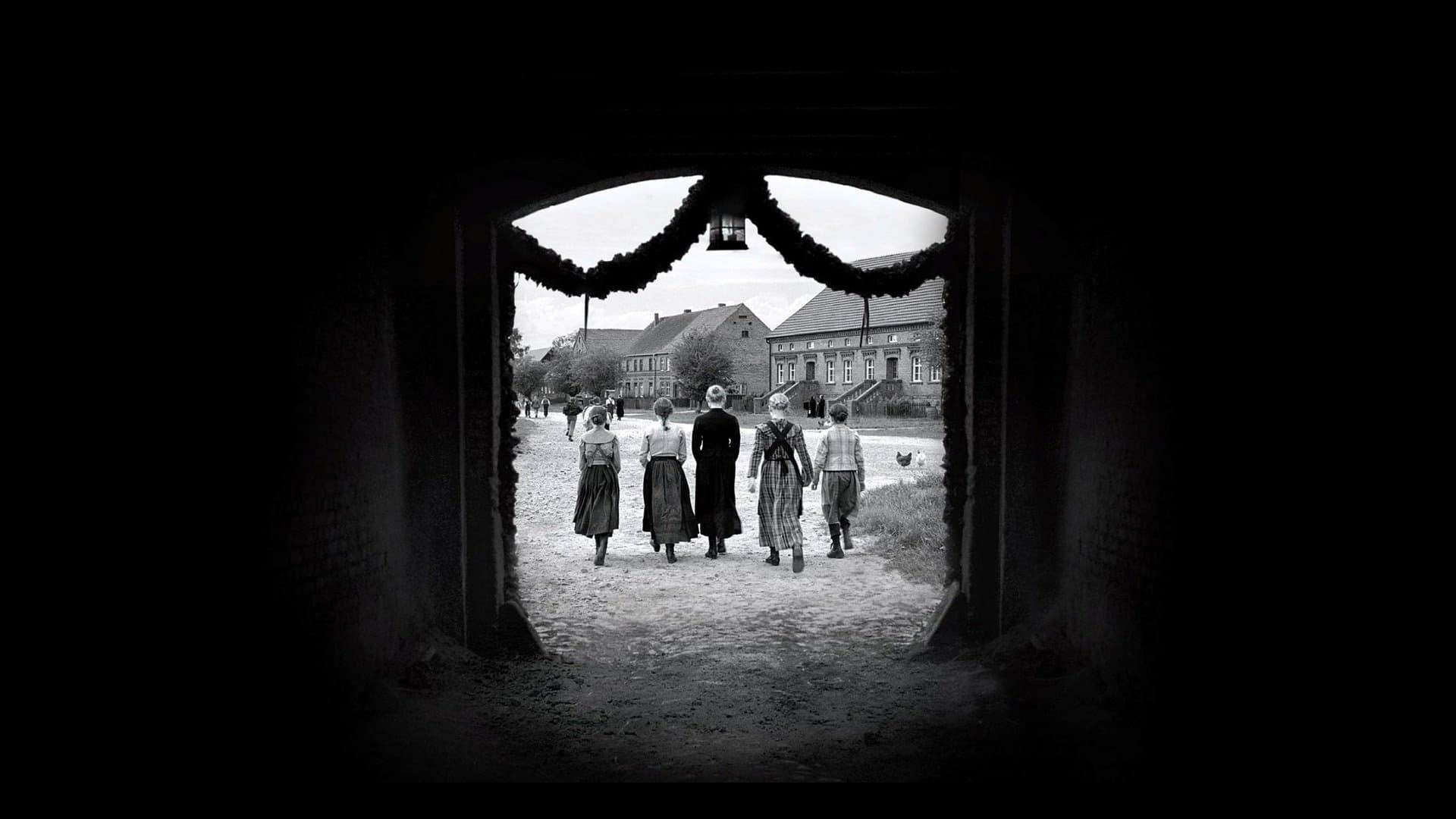
Michael Haneke’s The White Ribbon is set in the German village of Eichwald on the eve of the First World War. A schoolteacher recounts the history of its inhabitants, yet his narrative seems to exist outside fixed temporal and geographical coordinates. Whether the narrator lived to see the Second World War and the horrors of Nazism remains a mystery—as does the question of whether we can discern in these events the precursors to the twentieth century’s greatest catastrophe.
The film explores violence as it germinates within the mundane. The village serves as a concentrated site for the primary mechanisms of repression: the church absolves, the school disciplines, and the family punishes. Haneke constructs an archetypal society where adults are reduced to social functions and stripped of names—the Baron, the Pastor, the Doctor, the Teacher, the Midwife, the Steward. The children are similarly depersonalized: Pupil 1, Pupil 2, and so on. This schematic quality is heightened by a sense of isolation; the village appears as a closed loop, a space difficult to enter and seemingly impossible to escape. By staging a "theatre of cruelty"—showing functions rather than individuals—the director investigates the human origins of evil.
The rigid order of village life necessitates constant regulation, meaning violence and cruelty are effectively hardwired into the system. One gets the sense that this society produces evil autonomously, without the need for a specific trigger; the environment itself is the nutrient broth. Here, violence is neither an accident nor a glitch; it is immanent to reality, migrating from one situation to the next.
In The Human Condition, Hannah Arendt writes: "The miracle that saves the world, the realm of human affairs, from its normal, 'natural' ruin is ultimately the fact of natality... It is this faith in and hope for the world that found perhaps its most glorious and most succinct expression in the words with which the Gospels announced their 'glad tidings': 'A child has been born unto us.'" For Arendt, children symbolize the possibility of a radically new beginning—a chance to break the cycle of inevitability. But who are the children in The White Ribbon?
Within the patriarchal family, children exist in a state of perpetual fear and impotence; a child is forced to fetch the very instrument of their own punishment. For being late to dinner, they endure physical abuse, ritual humiliation, and the terror of the household head. The viewer might infer that this generation will later face national humiliation, a trauma that will haunt them and inevitably trigger a subsequent eruption of violence. The societal structure leaves no room for an alternative script: the world is submerged in a chain of crimes, one succeeding the other in an infinite loop. When the Doctor tells his daughter that beauty dooms one to suffering, we soon see the girl standing over a dead bird with scissors in hand—violence is reproduced.
Yet, are the children the collective vessel of evil? Haneke avoids a definitive answer, suggesting the question itself is not his primary concern. The audience is never led to a specific circle of perpetrators. As the plot unfolds, we do not draw closer to a singular source of malice; the narrative does not coalesce around a specific criminal. Instead, evil passes through a chain of indirect culprits. Because no crime is ever traced to a direct agent, every act feels accidental—a seemingly random, yet endless, succession of atrocities.
This impossibility of locating evil in a specific individual suggests that the source was already known: the disciplinary power of family, church, and school was the very medium that germinated the nightmare. In Haneke’s world, crimes are not psychological but social—they are symptoms of a specific time and structure.
The titular white ribbon serves as a vital tool of discipline. It functions not only as a mark of purification (the Pastor’s wife ties it on the children as a sign of innocence) but also as an instrument of shame. The children are forced to suppress their impulses until the pressure demands a release; the humiliated child is destined to project their frustration onto those even more vulnerable.
The white ribbon, as a symbol of "cleansing," becomes part of a corrupt system where religious ritual is used to whitewash reality. During confirmation, the Pastor suspects his children’s involvement in the village crimes, yet he proceeds with the rite, meeting further suspicion with indignation and threats.
The cycle of violence culminates in its most subhuman act: the brutalization of the Midwife’s disabled son. Here, the association with Nazi Germany becomes undeniable, shifting from the white ribbons (reminiscent of Hitler Youth armbands) to the "purification" of the nation from its most vulnerable members. No crime is solved, no connection is officially proven, and each new atrocity becomes more barbaric. Ultimately, the inhabitants are bound by an invisible thread of complicity; in Eichwald, everyone is simultaneously a victim and a perpetrator.