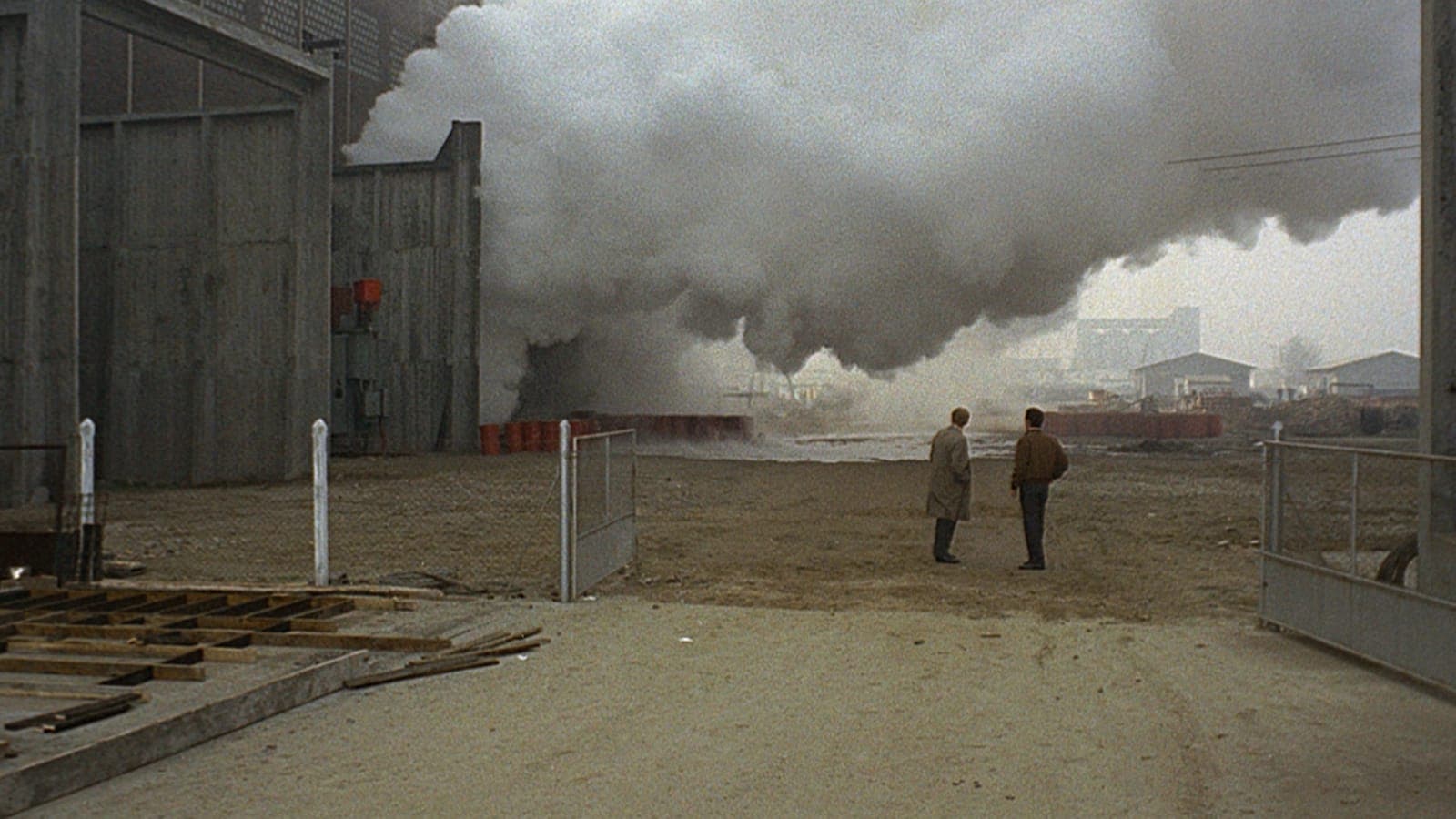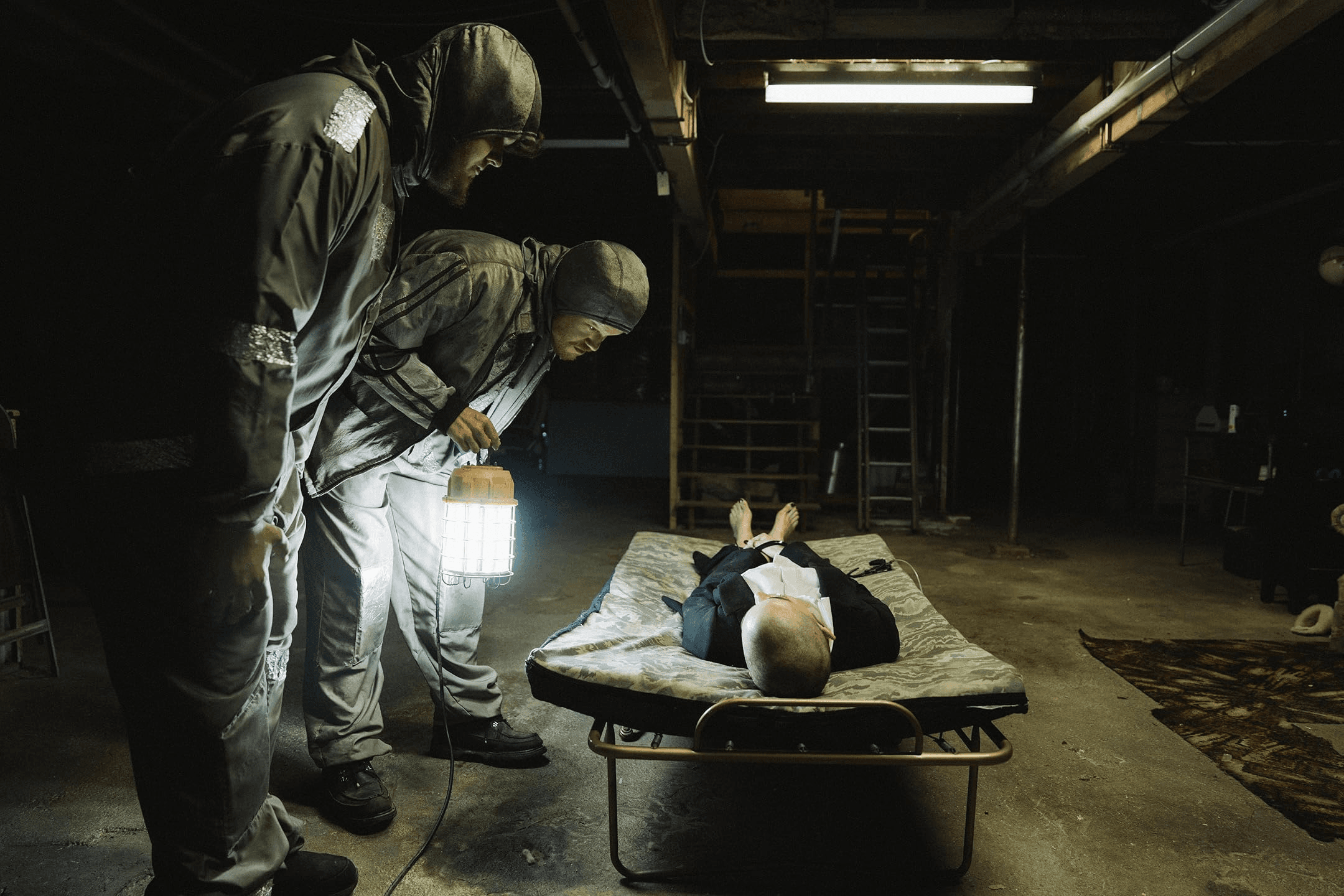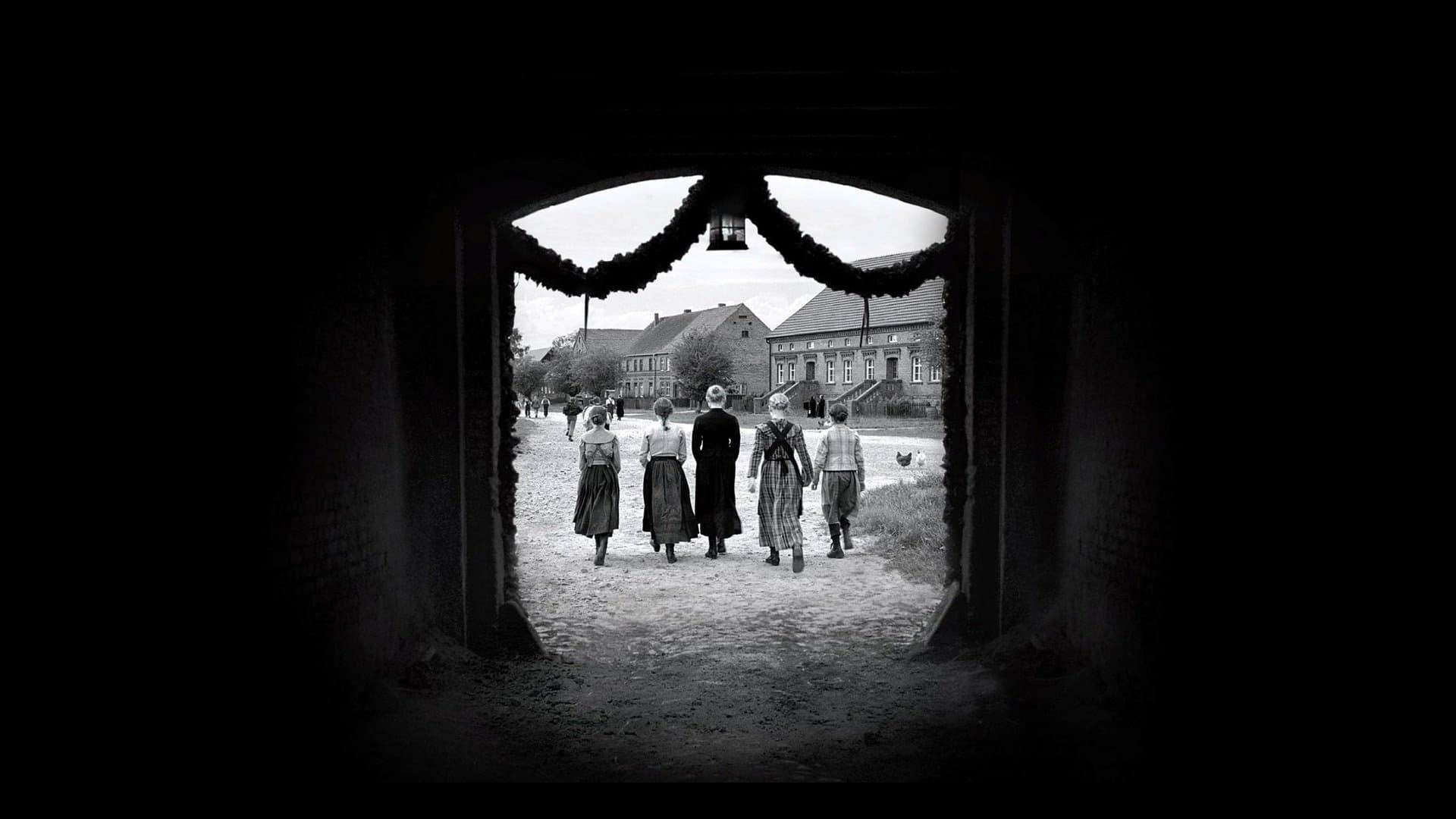
Already in the title — "A Pigeon Sat on a Branch Reflecting on Existence" — Roy Andersson establishes the necessary distance. The director invites us to look at human life not from the inside, not through the eyes of people entangled in their own affairs and anxieties, but from the outside — detachedly, as a pigeon sitting on a branch would. From this height, the tragic seems ridiculous, and the mundane appears absurd.
This perspective is not cinematic, but painterly. It evokes Pieter Bruegel the Elder. Take his famous "Hunters in the Snow": in the foreground, we see weary hunters with their dogs, but if you look closely, a whole world unfolds in the background — people skating, working, living their lives, unaware that someone is watching them from above. Andersson does the same, but through the medium of film: his camera is almost always static, positioned frontally, as if we are examining a tableau vivant.
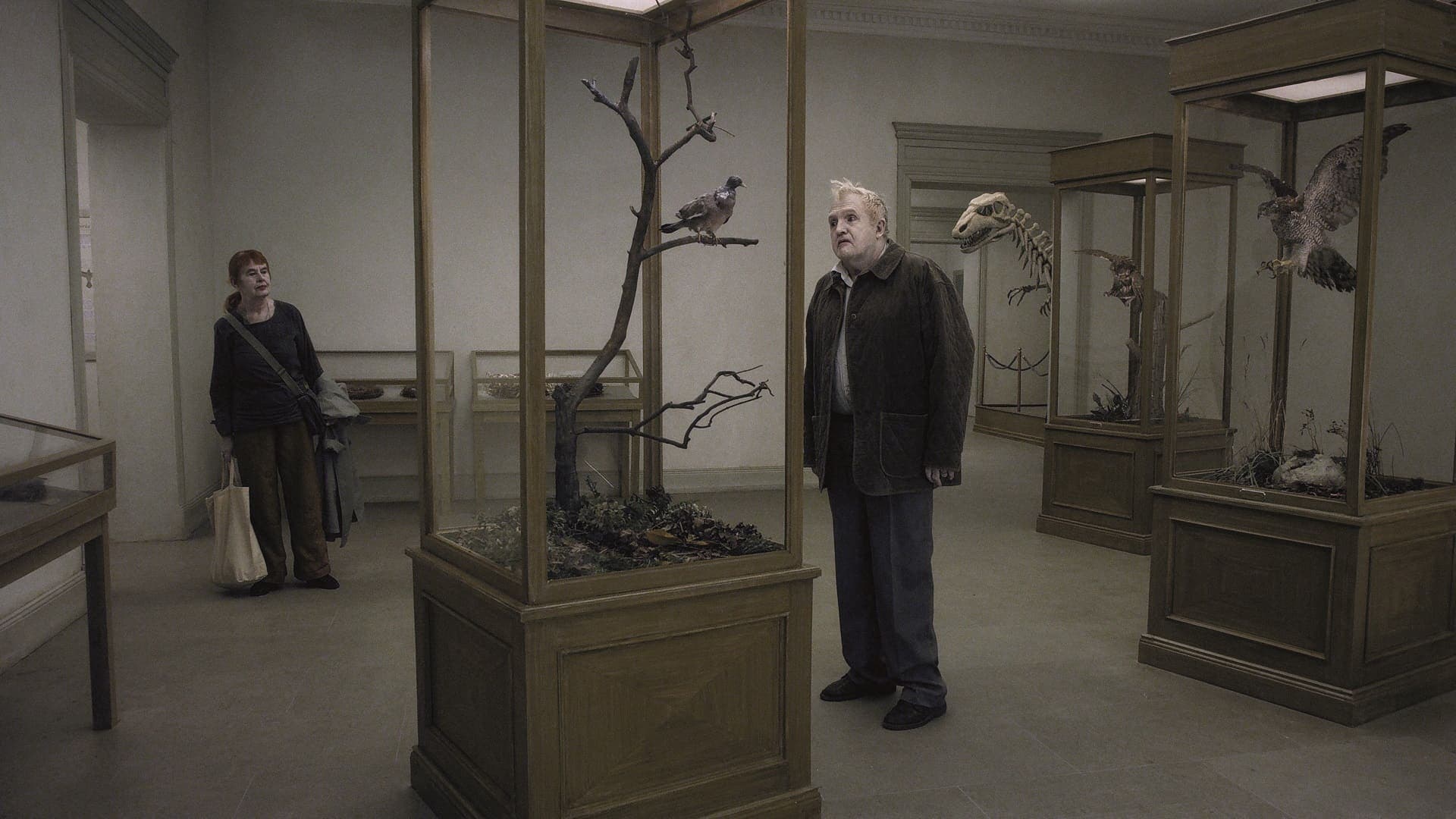
The film opens with a scene in a museum. A man wanders among stuffed animals enclosed behind glass. A little later, we see a scene at a deathbed: a dying elderly woman clutches a handbag with jewelry, while her children try to pry it from her. "She thinks she can take the bag to heaven... It doesn't work like that!" the son shouts. This petty attachment to the material on the threshold of eternity sets the tone for the entire film: history here is dead and unchanging, while people are laughable in their fuss.
But Andersson has no intention of leaving us in peace. The director breaks boundaries — between dream and reality, between past and present. The camera works like a surgeon's scalpel: it does not get intimately close to people, but dissects their existence. In one scene, we see a monkey with an open skull fitted with electrodes. The animal convulses while a woman nearby chats on the phone. This is a metaphor for our own condition: we exist without understanding what is happening to us, while everyone around repeats: "Everything is fine."
The World as Collective Oblivion
Having established this distance, the director immerses the viewer in a world of collective stupor, where life continues only by inertia. This is immediately apparent: the pale grey-green palette, the diffuse hospital light, the bloodless faces. The frame resembles a diorama — neatly arranged, motionless, where people continue to exist in a mode of eternal exhibition.
Routine becomes the only movement. Two salesmen — Sam and Jonathan — peddle "novelty items": vampire fangs, rubber masks, laugh bags. "We want to help people have fun," they utter with stone faces. They show off a new item, the "Uncle One-Tooth" mask, adding: "We believe in it very much." The phrase sounds almost religious: they "believe" in rubber and plastic as salvation. Their business is a precise metaphor for a world where alienation has reached its limit. Everything, including emotion, has turned into a commodity. People can no longer simply make each other laugh: if you want joy, buy a bag; if you want fear, put on a mask. Instead of living feelings, only their cheap surrogates remain.
Characters dial familiar numbers again and again, asking: "is everything alright?" The answer is always the same — like a password confirming the connection is established, but no conversation will follow. "I’m glad to hear you’re doing fine" is a formula that allows one not to enter another’s life and not to let anyone into one’s own.
People in Andersson's world barely act — they wait. They wait at bus stops, stand in lines, sit in bars, observing their own lives from the sidelines. In this collective oblivion, all characters walk like somnambulists: their eyes are open, but inside, they are asleep.
Awakening Through Nightmare: When Sleep Reveals the Truth
Realization comes in an unexpected way — through another dream, but this time a nightmare. Jonathan sees a horrific vision of the "Ship of Glory" — a luxurious hall where an elderly audience in evening wear watches an execution. In the center stands a huge bronze cylinder — a musical torture machine. Inside the cylinder, over a fire, are slaves. The cylinder rotates, and the screams of the dying turn into music for the guests. The audience drinks champagne, poured by an obliging waiter — Jonathan himself.
This scene stands out from the general flow of the film: it is louder and brighter than everything else. The bronze cylinder is an image of how civilization builds its well-being on the suffering of others, turning violence into a norm, into a spectacle.
Jonathan wakes up and exclaims: "It's terrible! And no one asked for forgiveness. Not even me." This is the only moment of awakening in the film — the realization of complicity in evil. But the world is not ready to wake up with him. His partner Sam replies irritably: "You shouldn't discuss such things in the middle of the night." "People have work tomorrow" is the universal excuse for not thinking about collective responsibility, history, or guilt. The world refuses to hear the one who has woken up and tries to drag him back into sleep. It is more convenient to remain in oblivion, where there is no need to think about anything or repent to anyone.
The Past Has Not Passed
The director's method is built on anachronistic aesthetics. The Swedish King Charles XII, with his entire 18th-century army, rides into a modern café. Soldiers in tricorn hats sit at tables, the king demands water, chases the women away, and takes the young bartender with him. No explanations, no montage cuts. By blurring the boundaries between eras, Andersson destroys the linearity of time. This technique allows him to seamlessly introduce themes of imperialism and slavery into the mundanity of life: the past has not ended; it has simply become part of the interior.
Later, we see the same Charles XII after his defeat — wounded, freezing, seeking a last bit of warmth. "His Majesty needs to use the toilet. — I'm afraid it's occupied. — That's a pity. Half the kingdom is lost." This dialogue in the bar perfectly deflates the pathos of grand history, colliding it with stubborn physiology.
History is not finished; it is happening right now. Andersson shows that history is not an arrow of progress, but a wheel. It turns, grinding people down, yet remains in place. Charles XII leads an army to death — and today armies march to death. People are tortured in the bronze cylinder — and today violence occurs somewhere while we drink coffee. There is no temporal distance here to allow us to feel safe. We are always on the battlefield, even if we are sitting in a bar.
And so Jonathan's question — "And no one asked for forgiveness?" — hangs in the air. To ask for forgiveness would mean admitting that the past is real, that it demands atonement. But in a world where time stands still, responsibility dissolves in the endless "now."
Timelessness: When Days of the Week Lose Meaning
In one scene, people at a bus stop suddenly start arguing: "What day is it today? Thursday? I thought it was Friday." This short line is a symptom of the loss of time.
Days of the week no longer carry meaning. Monday is no different from Wednesday. They simply follow one another like empty train cars. The South Korean philosopher Byung-Chul Han wrote that days used to be "narrative thresholds" — they structured life, giving time a plot and preventing it from slipping through one's fingers. But today, time "exists in time with the machines," uniform and monotonous. It knows only two states: work and the pause before work.
Andersson's world is stuck in precisely this gap, in an endless "inter-time" that is neither labor nor rest. It is limbo. Such timelessness is a direct consequence of the collapse of Big History. There are no more grand narratives of progress or salvation. Only a vacuum remains, an endless, empty now, in which we, like that monkey, keep moving because stopping is even more terrifying.
The Impossibility of Awakening — and Gestures of Resistance
In this dead world, there are still weak, almost imperceptible attempts at resistance. When words lose their meaning, the body remains — the little bit of life that has not yet finally extinguished. A flamenco dance teacher desperately tries to touch her student. She needs not just to dance, she needs to be seen, to be felt. Her gesture is awkward, almost aggressive, but it rhymes with another image — the dying king, who also reaches out to people so as not to freeze in loneliness.
The flamenco dancers are the only characters who act rather than observe. They move, expressing feelings through plasticity, through dance — an art form that does not enter history because it exists only here and now. But physicality in Andersson's work is not the victory of life over death, but a desperate hunger for the living. Touch becomes the last attempt to verify one's own existence when everything else has lost reality. Alas, these attempts are too weak to change anything: the teacher will never receive an answer, and the dancers will continue to dance into the void.
In this universe, there is no god who will descend from the heavens, and no revolution that will fix everything. Andersson shows a world that does not want to change. But there is a paradoxical consolation in this: we are all equally vulnerable, equally ridiculous, and lonely. And the only thing left for us is fragile gestures: to touch, to embrace, to dance. Not to defeat death, but simply to feel for a moment: I am still alive. We are still alive.