There are films that anticipate their era. And then there are those that peer half a century into the future. Michelangelo Antonioni’s Red Desert (Il deserto rosso) belongs to the latter. In 1964 — when the mass environmental movement was in its infancy and the word "Anthropocene" had yet to be coined — Antonioni filmed a world where industry had already subjugated nature, infecting it and subsuming it into its own logic. Here, the industrial landscape has penetrated the human interior to become a state of mind, and anxiety has transformed into the very air everyone breathes.
The Landscape After Nature
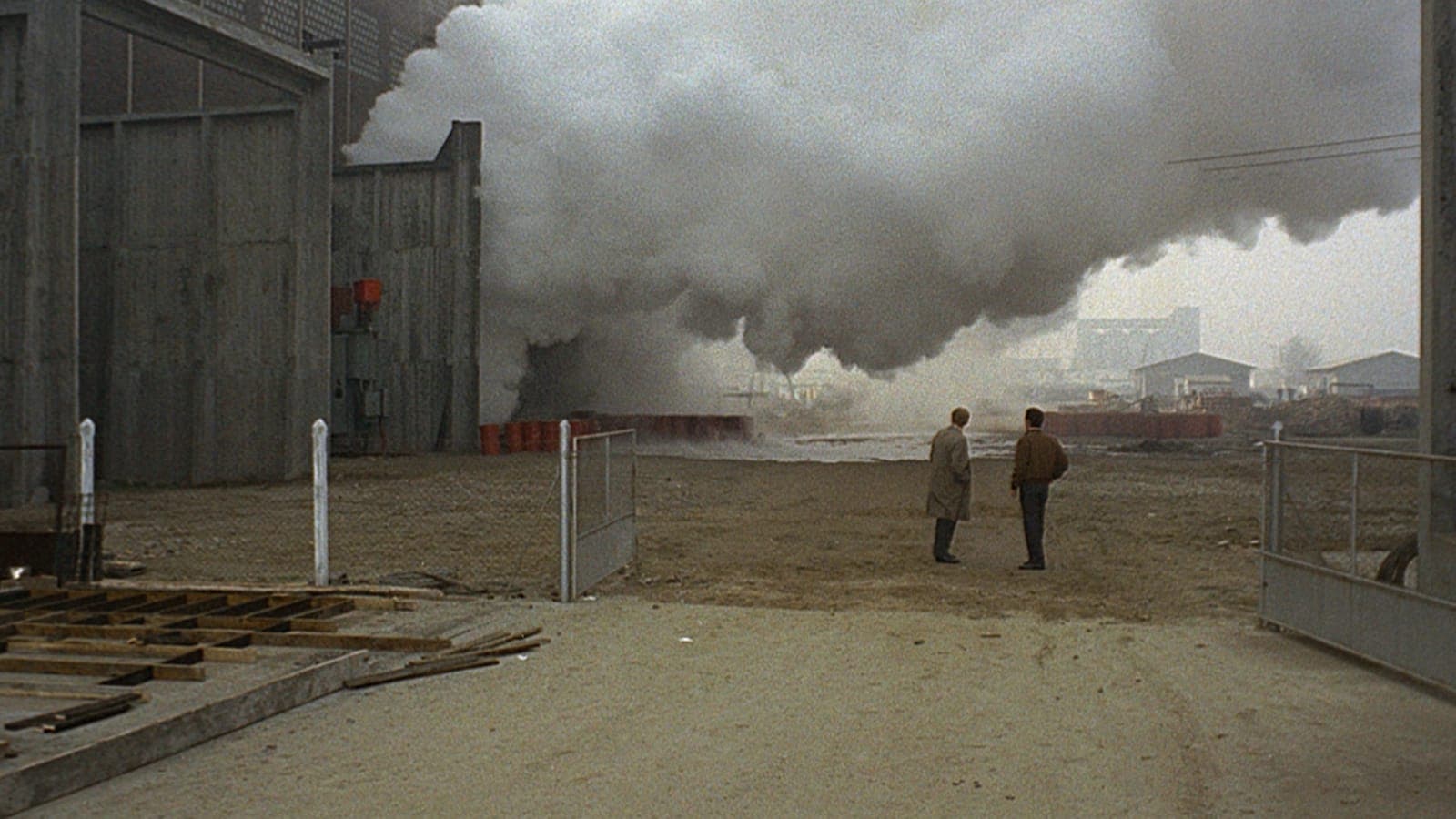
The opening shots of Red Desert are disorienting in their beauty. A grey sky bleeds into concrete; factory stacks belch plumes of smoke — yellow, white, orange — that do not dissipate but hang over the earth like a dense curtain. A woman in a toxic-green coat wanders across a wasteland. This is Ravenna, an industrial hub in Northern Italy, the early 1960s. Yet, it looks like footage from another planet or a world post-catastrophe.
The director captures a reality where the industrial landscape is no longer merely the "destruction of nature," but the replacement of one environment with another. Technology has become the ecosystem; humans live inside it, breathe its air, and see through its eyes. In this sense, Red Desert is a manifesto for an era in which human activity has become the dominant geological force. The industrialization of the 20th century altered not only the landscape but the perception of it. The world changed, and the human changed with it.
After her hospitalization, Giuliana cannot "reset to normal." As the plot unfolds, it becomes clear that her fracture occurred long before the car accident. She sees what others have learned to ignore: the smoke, the filth, the void. She feels what others have learned to suppress: the horror that the world has turned hostile, and there is no way back. Anxiety, alienation, and numbness are natural reactions to a mutated environment. In the film, ecological catastrophe is presented not as an event, but as an internal state.
The Landscape as Protagonist
In classical cinema, the landscape is a backdrop against which action unfolds. For Antonioni, the reverse is true: the industrial landscape does not merely accompany the characters — it is the protagonist. Smokestacks, reservoirs, waste dumps, and concrete barrens are not just present in the frame; they crowd the people, pushing them to the margins of their own lives.
Nature in this world has been entirely displaced. Even when the characters drive out of the city, they do not arrive in the bosom of nature, but merely at different industrial wastelands. Any patch of earth not yet paved over looks temporary, simply waiting for technology to arrive and assign it a function. The untouched, "unknowable" sea appears only once — in the fable Giuliana tells her son about pink sand and transparent water. It is a mythic space, an archetypal image of the world before the Fall, before the intrusion of man.
Yet, this world of artificiality reveals itself as a world of art. Cinematographer Carlo Di Palma (who would later work with Woody Allen) transforms industrial grime into painting. Streaks of rust on metal, pools of chemical waste, peeling paint on walls — all begin to read as abstract expressionism. We recognize the color fields of Mark Rothko and Barnett Newman, the metaphysical spaces of Giorgio de Chirico, the free forms of Jackson Pollock and Lee Krasner.
There is a palpable resonance with Georgia O'Keeffe, who turned the American desert into a source of visionary experience. Her dead landscapes, skulls, and twilight skies were born of a world where nature had receded or died. Antonioni does the same, but instead of the American Southwest, he uses an Italian industrial zone. He blows up details of the landscape until they lose their specificity and become pure form, color, and texture.
A paradox emerges: where there should only be depression and decay, Antonioni discovers a space for a sublime aesthetic experience. Beauty has not vanished from the world; it has mutated, adapting to new conditions. However, this aesthetic is all the more unsettling because it exposes the absurdity of the situation: we have learned to find the beautiful everywhere, but beauty no longer saves the world.
The Ambivalence of Color
The director works with color ambivalently: on one hand, bright, artificial hues heighten the heroine's anxiety; on the other, they provide her with a fragile emotional and aesthetic anchor.
Giuliana’s emerald-green coat, her copper-red hair, the red niche in the wooden shack, the pink artificial flowers — these are islands of life, reminders that the world was once different. Yet simultaneously, these same colors amplify alienation: they are too bright, pushed to the limit, chemical, synthetic. The green of Giuliana’s coat is not natural — it is the color of industrial dye, aggressive and alarming. The red is not warm, but feverish. These colors do not oppose the industrial world; they are a part of it, a symptom of it.
According to the crew, Antonioni had entire streets, trees, and grass painted to achieve the specific shades he needed. When reality was not expressive enough, it had to be amplified, made more artificial than it was, to reveal its true nature.
Fog and smoke constantly shroud the buildings, blurring their contours. The sharp lines of factory structures dissolve into this haze, turning into pure abstraction. Reality refuses to be defined. The boundaries between objects, between figure and ground, between human and environment, are washed away. Human voices mix with the sounds of production on equal terms; neither takes precedence.
The border between the natural and the artificial is finally erased. In fact, the "natural" no longer exists — there are only varying gradients of artificiality, different regimes of toxicity.
Technology as Total Environment
One of the film’s most striking scenes is shot with almost no camera movement: Giuliana looks out a window, and suddenly, an immense ship rises into the frame. It moves so close to the shore that it blocks out everything — the sky, the horizon, the entire visible world. All that remains is its black hull, drifting slowly past like a wall with no end. This is the image of technology — a total environment that has swallowed everything else. It is also a new optic: productivity, efficiency, utilization. Everything must be useful; everything must yield a result.
The system needs humans, yet simultaneously, it does not need them. The factories in the film are nearly empty. There are many shots where machinery exists for itself, in a frightening autonomy: gears turn, conveyors move, systems operate — but there are no people, or they flicker somewhere on the periphery as incidental elements.
Technology is constantly expanding — it requires new territories, new resources, new markets. Corrado, the engineer, is flying to Patagonia — a place where there is still something to exploit, where the system can continue its expansion. But in this expansion, man is merely material, as expendable as oil or ore. He ceases to be distinguishable; he is absorbed. The scene where the characters vanish into the thick industrial fog is a direct metaphor for this dissolution.
The Accident as a Glitch
From the system's perspective, Giuliana is a broken part. She is counter-productive: she panics at a shop opening, plans to leave with her husband only to refuse at the last moment, and cannot focus on simple domestic tasks. They try to fix her: her husband takes her to doctors and sends her to a clinic, hoping to "replace the broken component," to "tune the mechanism so it runs again."
On the street, Giuliana meets a worker she knew in the hospital. In the clinic, he was alive, distinct — he stood out. Now, back at the factory, he is gray, erased, indistinguishable. The system has accepted him back, and he has disappeared into it, just as one disappears into the fog.
Corrado, the engineer, family friend, and potential lover, is Giuliana’s mirror image. He embodies technological consciousness in its pure form: active, rational, results-oriented. Yet his activity lacks peace. It is not the energy of life — rather, it is running in place, an attempt to drown out inner emptiness with work. If Giuliana has broken down and cannot function, Corrado functions but cannot stop. He, too, is a victim of the system.
The sex scene between Corrado and Giuliana is one of the film’s most unbearable sequences. Corrado approaches intimacy as an engineering task: desire must be implemented. He tries to use sex as a tool, a way to "discharge" her anxiety, to return her to a normal state. But Giuliana’s desire, fear, and confusion cannot be calculated. What should be a human act turns into another operation — cold and devoid of meaning. Sex in this world has become as impossible as everything else that requires presence rather than productivity.
The Last Refuge
The "Red Room" in the port — part of a wooden shack painted a vivid red — is the only space in the film where the "human" is still possible. Corrado, Giuliana, and their friends gather there to pass the time. It is a liminal, hidden space. Here, one can talk, laugh, and be inefficient. Here, excess, play, and Eros are permissible. One character tells a story of a Turkish sailor and his lover who hid in this room. The story is tawdry, yet it is delivered with almost tender nostalgia, a memory of a time when human desires still meant something.
But this refuge is not destined to survive. The shack grows cold, and to keep warm, the characters begin to destroy it themselves. They rip planks from the walls, break the painted wooden furniture, and throw it all into the stove. This happens gleefully, almost ecstatically. For the sake of momentary warmth, they annihilate the space they inhabit. This scene is one of the film’s bitterest metaphors. The principle of utility automatically wins, even within a circle of "friends": if there is wood, it must be used. The beauty and intimacy of the Red Room burn in the fire; there is nowhere left to hide.
Learning to Live in the Smoke
In the finale, Giuliana and her son walk along the industrial zone near the factory. Throughout the last part of the film, the boy has feigned illness — simulating paralysis in his legs, frightening his parents. But perhaps this was his own form of rebellion, an unconscious attempt to opt out of the productive world. To test if freedom can be found by pretending to be a broken cog and ceasing to function.
Now that the deception is revealed, he walks again. They stop by the factory, and the boy asks about the yellow smoke billowing from a stack: "Do the birds know it’s poisonous?" Giuliana answers: "Now — they know. Before, they flew through it and died. But now they have learned to fly around it."
Antonioni offers no promise of a return to nature, nor does he offer the comfort of a coming revolution. The only possible path is mutation. To develop new ways of existing, to become something else — no longer human in the traditional sense.
Sixty years have passed since the release of Red Desert. Human activity has altered the chemical composition of the atmosphere, ocean temperatures, and species migration. The boundary between the natural and the artificial has been definitively blurred: plastic is found in deep-sea trenches, synthetic microparticles in human blood, industrial chemicals in Arctic ice. What was the space of a single city in Antonioni’s film is now a planetary condition.
The film also anticipated how the technosphere manufactures a new type of subjectivity — humanity's nervous system, its capacity to feel, its relationship to time and space. Infrastructures (digital platforms, logistics chains, optimization algorithms) have become a habitat we no longer notice. It is invisible, like air. And just like the air in Antonioni’s film, it is toxic. Psychologists now record a rise in "eco-anxiety" and "climate depression" — states where the source of unease is not a specific threat, but the very atmosphere of existence.
We live inside a world we created, which now dictates its laws to us. The question is not how to fix everything, but what choice to make: to pretend that everything is fine, or to continue to see and feel — even if the price for doing so is too high.